Drupal Alternatives (2026): 5 Best CMS Platforms Compared

You finally get approval to launch a new campaign. The landing page needs to go live in three days. You open your CMS, make what should be a simple edit, and somehow the entire navigation breaks.
You call the agency. They'll get back to you in a week. Sound familiar?
This is the Drupal experience for most marketing teams. And it's why thousands of companies are actively searching for Drupal alternatives that let them move fast without needing a developer on speed dial.
This guide is written for marketing managers, growth leads, content teams, and founders who are responsible for their company's website but didn't sign up to become a CMS administrator.
We'll compare five platforms that solve real marketing problems.
What is a CMS, and why does Drupal feel like the Wrong Answer
A content management system (CMS) is the tool your team uses to build and update your website without touching raw code.
The right CMS should let you ship a landing page in hours, not weeks.
Drupal is one of the most powerful open-source CMS platforms in the world.
It powers complex government portals, university systems, and enterprise sites with hundreds of thousands of pages.
That power comes with a price: deep learning curves, heavy reliance on developers, complex module management, and update cycles that can break everything if handled incorrectly.
The pros and cons of Drupal are well documented.
On the plus side: Unmatched flexibility, strong security, robust API capabilities, and a massive developer community.
On the downside, it is not built for marketers. It's built for developers managing complex content architectures.
When businesses reach the 20–50 employee stage and have a dedicated marketing team, the mismatch becomes painful.
Drupal solutions require ongoing developer attention, like patching, module updates, and performance tuning.
Most marketing teams don't have that internal capacity, and outsourcing it to an agency creates dependency that slows everything down.
That's the real reason companies look for Drupal alternatives. Not because Drupal is bad.
Because it's the wrong tool for what a modern marketing team actually needs.
5 Best Drupal Alternatives for Marketing Teams
We evaluated these platforms on four factors:
- Ease of use for non-technical teams
- Time-to-publish
- SEO readiness
- Total cost of ownership, including hidden agency fees
JET-CMS
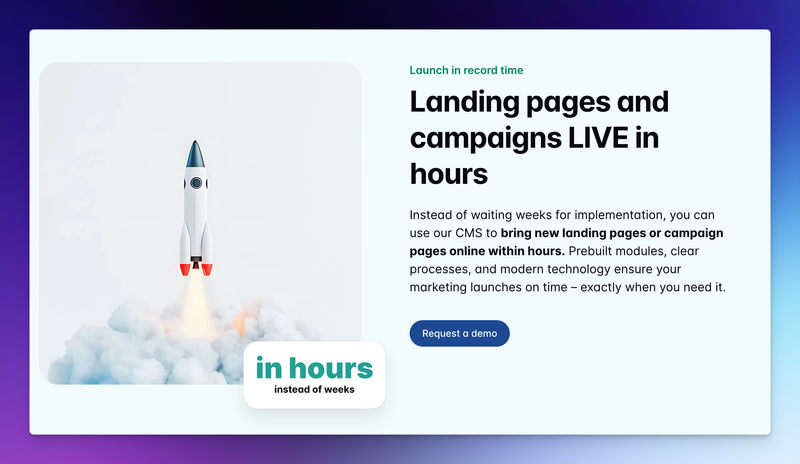
JET-CMS is a CMS built specifically for marketing teams in mid-sized companies who want to manage landing pages and campaigns without touching code or waiting on IT.
Unlike most open-source Drupal competitors that still require developer setup, JET-CMS is designed so that a marketing manager can make changes confidently without fear of breaking anything.
The platform is structured around a simple principle: marketers should only touch text and images. The underlying architecture, design system, and corporate branding are locked in place.
That means you can update a campaign page in minutes, knowing it will still look professional and load fast when you're done.
The standout feature for global teams is AI-powered multilingual publishing. Campaigns that used to take weeks to localize can go live in hours across multiple languages.
Best for: Marketing teams at SaaS companies, B2B firms, and service businesses who want to stop depending on agencies for every website change.
Key features:
- Safe content editing: Change text and images without breaking layouts
- AI-powered multilingual publishing
- Custom branding locked to corporate design system
- GDPR-compliant EU data storage
- Maintenance-free operation: No plugins, patches, or updates to manage
- Built-in SEO optimization at the infrastructure level
Pricing: Custom pricing based on company size and usage. Contact JET-CMS directly for a custom quote.
Honest Take:
JET-CMS is genuinely narrow in scope. It's not trying to be a full website builder or a developer platform.
If you're a marketing team that needs to publish fast, stay on-brand, and never worry about a plugin update breaking your homepage, it's one of the simplest Drupal alternatives available.
It won't work for teams that need deep customization control or custom development workflows. But for its target use case, it removes more pain than any other tool on this list.
WordPress
WordPress powers roughly 43% of all websites globally. It's the most widely used CMS in the world, and for good reason, it has an enormous ecosystem of themes, plugins, and developers who know it well.
As a Drupal competitor, it wins on pure market penetration and plugin availability.
That said, WordPress has its own version of the Drupal problem for marketing teams.
With great flexibility comes complexity. The more plugins you install, the more things can break. Updates need to be managed.
Security patches are a real concern.
Most marketing teams eventually hit the same wall: they're spending more time maintaining the site than publishing on it.
Best for: Companies with access to a WordPress developer or a managed hosting plan that handles maintenance. Also good for content-heavy blogs and editorial sites.
Key features:
- Massive plugin ecosystem 61000+ plugins
- Huge talent pool of developers and designers
- Gutenberg block editor for visual page building
- Strong SEO plugins like Yoast and Rank Math
- Flexible enough to build almost anything
Pricing: WordPress software is free and open source. Hosting starts around $30–$50/month for managed plans. Premium themes and plugins add $200–$2,000+/year depending on needs.
Honest Take:
WordPress is the most popular Drupal alternative for a reason, but it comes with hidden costs.
Without a developer or a managed plan, the maintenance burden falls on whoever "owns" the website, usually the marketing team.
If your team has broken a WordPress site before (and most have), you know the drill. It's powerful when managed well. It's exhausting when it's not.
You can also look into our guide about Drupal vs WordPress.
Contentful
Contentful is a headless CMS. Meaning it separates your content from its display.
Editors manage content through a structured interface, and developers control how it renders on the front end. It's one of the leading Drupal competitors in the enterprise space, particularly for companies with complex content workflows across multiple channels.
The editing experience is clean and well-organized.
Content types are highly customizable. APIs are excellent. But here's the honest reality: Contentful is a tool built around developer workflows. Non-technical marketers can use it, but only within the constraints developers set up for them.
Best for: Mid-to-large companies with dedicated engineering teams who want to decouple content management from the front end.
Key features:
- Headless architecture: Publish content anywhere via API
- Strong content modeling and structured content
- Rich localization and multilingual support
- Integrates with modern front-end frameworks (Next.js, Astro, etc.)
- Workflow and approval tools for editorial teams
Pricing: Free tier available with limits. Lite plan starts at around $300/month. Premium enterprise pricing is available on request.
Honest Take:
Contentful is excellent if you have engineers. If you don't, you'll hit a ceiling immediately. You'll need a developer to set up content types, configure previews, and manage the front end.
It's a strong platform with real capabilities, but it is not a tool for marketing teams operating without technical support.
The pricing also scales quickly, which matters for smaller companies watching their SaaS spend.
Webflow
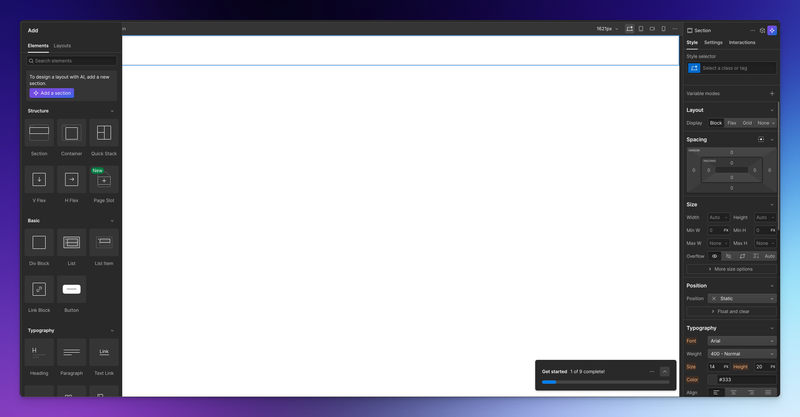
Webflow sits between a website builder and a real CMS. It gives designers and semi-technical marketers the ability to build visually while generating clean code in the background.
It's gained serious traction as a Drupal alternative for agencies and design-forward companies.
The visual builder is impressive. You can create responsive layouts, animations, and interactions without writing CSS from scratch.
The CMS collections work well for blogs, product pages, and repeatable content. There's also a hosting layer included.
The gap shows up when non-designers try to use it. Webflow's power comes from understanding layout concepts.
People without a design or front-end background often find it confusing, and mistakes are easier to make than they appear.
Best for: Design-led agencies, startups with a designer on the team, and companies that prioritize visual control over publishing speed.
Key features:
- Visual, no-code design tool
- CMS collections for dynamic content
- Built-in hosting with decent performance
- Strong animation and interaction capabilities
- Integrates with Zapier, Make, and other automation tools
Pricing: Free tier available. Site plans start at $14/month (basic) and go up to $39/month (business plan).
Honest Take:
Webflow is genuinely impressive for people who think in visual design terms.
For marketers who want to edit a headline and update a hero image without touching a component hierarchy, it can feel unnecessarily complex.
Several marketing teams report that making small edits in Webflow leads to layout issues they can't diagnose.
It's a better creative tool than it is a content management tool for non-technical operators.
You can also read our guide about WordPress vs Webflow.
Sitecore
Sitecore is an enterprise-grade CMS and digital experience platform. It sits firmly in the Drupal solutions category for large organizations.
Think global brands, financial institutions, and healthcare companies with multi-region content needs and large IT departments.
It offers deep personalization, A/B testing at scale, marketing automation, and multilingual content management. It integrates with major CRM and analytics platforms. The architecture is robust and built for mission-critical environments.
Best for: Large enterprises with dedicated development teams, complex content governance needs, and budgets to match.
Key features:
- Enterprise personalization and A/B testing
- Advanced workflow and governance
- Omnichannel content delivery
- Integration with Salesforce, SAP, and major enterprise tools
- Strong analytics and reporting layer
Pricing: For enterprise pricing, contact support.
Honest Take:
Sitecore is powerful, but it's also in a category of its own. Most mid-sized companies that are looking for Drupal alternatives aren't Sitecore candidates. The implementation complexity alone requires a dedicated team or a specialized agency partnership.
If you're a 20–50 person company, this is almost certainly not the right tool. If you're an enterprise with complex digital experience requirements, it's worth evaluating.
Final Words
No CMS is perfect for everyone. The right choice is the one your team will actually use confidently, without needing to submit a ticket or send a Slack message to engineering every time you need to update a page.
Turn your CMS into a growth engine – not a blocker
If every new landing page depends on plugins, developers and workarounds, it’s time to rethink your setup. With JET-CMS, marketing teams launch campaigns, multilingual pages and updates in hours instead of days – without plugin chaos or tech stress.

FAQs
No. Drupal remains actively maintained with a strong developer community. It remains a strong choice for government and enterprise deployments where developer resources are available. It is simply not well-suited for marketing teams operating without technical support.
With a managed hosting plan and a simple theme, yes, to a degree. But the risk of breaking something during plugin updates or theme changes remains real. Most marketing teams eventually hit a wall without some developer involvement.
In most cases, yes, at least partially. Content can often be migrated in bulk, but templates, design, and custom functionality typically need to be rebuilt for the new platform. This is a real cost to factor in, but most companies find the long-term efficiency gains justify the upfront migration investment.