Drupal vs WordPress (2026): Quick and Easy Guide for Marketing Teams

It's Tuesday afternoon. Your CEO asks for a small homepage change before tomorrow's campaign launch: just a headline tweak and a new CTA.
You log into WordPress, change a headline, accidentally break the layout, and spend the next hour trying to fix it.
Sound familiar? If you're a marketing manager managing a website you didn't build, you're not alone. The Drupal vs WordPress debate has raged for years, but in 2026, the real question isn't "which is better?" It's "which lets me sleep at night?"
This guide is for marketing professionals at mid-sized companies who need to ship pages fast without breaking things.
We'll compare WordPress vs Drupal, examine security, and introduce alternatives that might actually solve your problem.
Drupal vs WordPress Debate and Why Does It Matter?
Both Drupal and WordPress are open-source content management systems that let you build websites without coding from scratch.
The numbers tell a clear story:
- WordPress powers 43% of all websites and holds 60% of the CMS market
- Drupal runs 2% of websites with 4% market share
- Both have existed for over 20 years
For marketing teams, this affects three critical areas:
- Speed to publish. How quickly can you create pages without waiting on developers?
- Risk of breaking things. How easy is it to accidentally mess up your site?
- Independence from IT. Can your team actually own the website, or are you perpetually dependent on technical help?
The traditional wordpress vs drupal comparison focuses on technical capabilities.
For marketing teams, it's about control, confidence, and getting campaigns live before opportunities pass.
Best CMS Options for Marketing Teams
Let's be honest about what each platform actually delivers in the real world. We evaluated these based on ease of use for non-technical teams, time to publish, maintenance burden, and the risk of accidentally breaking something.
WordPress
WordPress evolved from a 2003 blogging platform into the world's most popular CMS. It uses themes for design and plugins for functionality.
Best for: Small businesses, blogs, and companies with in-house developers or reliable agency support.
Key features:
- Nearly 60,000+ plugins available
- Thousands of themes
- Gutenberg block editor for visual building
- Large community for help and tutorials
- Lower upfront development costs
Pricing: WordPress is free. But it comes with hosting, themes, and plugins costs.
Honest Take:
WordPress is flexible and can do almost anything with the right plugins.
But that flexibility creates complexity.
You're managing constant plugin updates, themes that break, and a dashboard where a single wrong click can bring everything down.
The software is free, but the hidden cost is waiting on agencies, IT tickets, and stress from broken sites. If you have dedicated developers, WordPress works. If you're a marketer managing it alone, it's exhausting.
You can also read our guide about WordPress alternatives.
Drupal
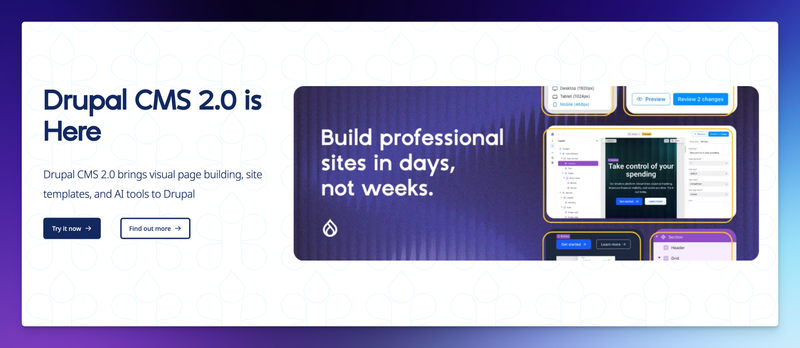
Drupal launched in 2001 as a powerful framework for building complex, highly customized websites. Built for developers who need granular control.
Best for: Large enterprises, government agencies, universities, and organizations with complex data structures and strict security requirements.
Key features:
- Advanced content modeling and custom content types
- Granular permission controls
- Enterprise-grade security
- Built-in multilingual support
- API-first architecture for headless implementations
Pricing: Drupal core is free. Hosting and Initial Development are higher due to custom requirements compared to WordPress.
Honest Take:
Drupal is genuinely powerful and secure.
If you're the White House or Harvard, it makes sense. But for marketing teams? This is overkill.
The learning curve is brutal.
Making simple changes requires understanding content types, views, and blocks, concepts that shouldn't be your job to learn.
The debate over Drupal vs. WordPress security is real, but most marketing sites don't need enterprise-grade security. Drupal's complexity far outweighs its benefits unless you have specialized needs and budget.
JET-CMS: An alternative to Drupal and WordPress
Specialized CMS built specifically for marketing teams at mid-sized companies. Designed around the principle that marketers shouldn't need technical expertise to manage websites.
Best for: Marketing teams at 20-50 employee companies who want independence from IT and agencies while maintaining professional quality.
Key features:
- Publish pages in hours, not weeks
- AI-powered multilingual translation
- Custom corporate branding
- Maintenance-free with EU hosting
- Dedicated Vercel servers for fast load times
- GDPR-compliant
- Safe changes, no breaking things
Pricing: Contact for pricing. Designed for mid-sized budgets with predictable costs.
Honest Take:
This addresses the pain point most marketing teams actually experience. Instead of giving you a powerful but complicated tool and hoping you figure it out, JET-CMS asks, "What do marketing teams need to do?"
The answer: create landing pages, run campaigns, translate content, and make changes safely without developers. That's what it's built for. The trade-off is customization, you won't be able to create complex web applications.
But if you're honest about what your marketing team needs versus what you theoretically might need someday, this could be your answer. It's for teams tired of powerful but exhausting tools.
How to Choose the Right CMS for Your Marketing Team
Forget technical specs. Here's how to actually decide:
Start with your real goal:
- Complex e-commerce? WordPress with WooCommerce
- Highly sensitive data? Drupal
- Does the marketing team need campaign independence? JET-CMS or similar platforms
- Have dedicated developers? WordPress or Drupal works
Your team's technical skills:
- No technical background, nobody wants to learn? Avoid WordPress and Drupal
- One technical-ish person? WordPress might work with page builders
- Actual developers? Any platform works
Calculate real costs:
- Initial build is just the start
- Factor in ongoing agency retainers
- Account for the productivity cost of waiting for help
- Consider stress and troubleshooting time
- Compare the total cost over 2-3 years
Think about content workflow:
- Publishing frequency?
- How many content creators?
- Need multilingual content?
- Campaign launch frequency?
Privacy and compliance:
- GDPR matters for EU users
- Industry-specific security standards
- Data residency requirements
Scale plan realistically:
- Don't over-engineer for theoretical needs
- Most sites don't need a millions-of-users scale
- You can migrate later if needed
Combining tools is normal:
- WordPress for blogs, specialized tools for landing pages
- Multiple platforms for different needs
- Marketing teams typically use 3-5 tools
The trap is choosing based on popularity or what sounds professional.
Pick what makes your work easier.
Final Words
The Drupal vs WordPress debate is fundamentally a question developers care about, not one marketing teams care about.
Both platforms are powerful and can accomplish similar goals. But for marketing professionals without technical backgrounds, powerful often means complicated and scary.
Your CMS should fade into the background, letting you focus on marketing. If you're constantly worried about breaking things or waiting on developers, your tool is failing you regardless of technical capabilities.
The best CMS lets you publish campaigns when opportunities arise, make changes without fear, and ship pages in hours instead of weeks.
Before committing to any platform, actually use it. Make changes. Build a landing page. See how it feels. The decision becomes obvious once you stop reading about features and experience the daily reality.
Turn your CMS into a growth engine – not a blocker
If every new landing page depends on plugins, developers and workarounds, it’s time to rethink your setup. With JET-CMS, marketing teams launch campaigns, multilingual pages and updates in hours instead of days – without plugin chaos or tech stress.

FAQs
Migrating from drupal to wordpress is technically possible but rarely simple. Content moves, but you'll rebuild structure, features, and design from scratch.
Drupal has stronger out-of-the-box security and fewer vulnerabilities. WordPress faces more attacks due to its popularity and its plugin ecosystem.
Technically, yes. Practically, it's exhausting. WordPress is more approachable than Drupal, but developers designed both. Marketing teams can learn basic content updates, but constantly hit technical limitations. Simple tasks like new landing pages or layout changes often require plugins, code, or developer help.