5 Essential Tools for Digital Marketers in 2026 (That Actually Save Time)

It's Tuesday afternoon, you have a campaign going live on Friday, and your landing page still needs three copy changes and a new hero image.
You submit a ticket to IT. They say next week. You call the agency. They say it takes a minimum of 2 business days and quote you $400.
You end up copying the page into a Google Doc and emailing it around to get something done.
Sound familiar?
Tools for digital marketers have multiplied faster than any team can keep up with.
There are platforms for everything: analytics, automation, design, SEO, and content.
But most of them were built for specialists, not for the marketing manager who also handles the blog, the ads, the social calendar, and somehow the website too.
This guide is for marketing professionals at small-to-mid-sized SaaS, agency, e-commerce, and B2B companies who need tools that work without a learning curve.
We have selected five tools that genuinely reduce friction, cut down production time, and let you move at the speed your campaigns actually demand.
We will cover what each tool does, who it is for, what it costs, and the honest trade-offs.
What are Digital Marketers Tools and Why Do They Matter?
Digital marketing tools are software platforms that help marketing teams plan, execute, and measure campaigns across digital channels.
At their best, they remove manual work, reduce dependency on technical teams, and give marketers real-time visibility into what is working.
The difference between a team running on the right stack and one running on the wrong one is not subtle. It shows up in:
- Campaign launch timelines (weeks vs. hours)
- Content consistency across channels
- How quickly can you respond to data
- How much of your budget goes to agencies instead of actual media spend
The challenge is not finding tools, there are thousands of them.
The challenge is choosing tools that your team will actually use, that fit together, and that do not require a developer to configure every time something needs to change.
The 5 Best Tools for Digital Marketers in 2026
We selected these tools based on four criteria: ease of use for non-technical marketers, measurable time savings, quality of output, and realistic pricing for growing teams.
JET-CMS
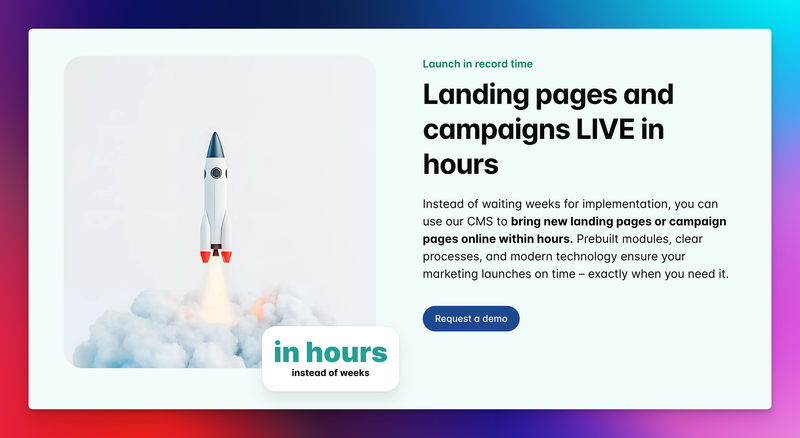
JET-CMS is a content management system built specifically for marketing teams who need to manage landing pages and campaigns without touching code or waiting on IT.
Unlike general-purpose CMS platforms such as WordPress or Webflow, JET-CMS is designed around a single core promise: marketers can make changes safely, quickly, and independently.
You edit text and images through a clean interface, and the page updates without risking layout or site structure breaks.
Best for: Marketing managers, heads of growth, and founders acting as their own marketers at companies with 10 to 50 employees who are currently stuck waiting on agencies or IT to publish even minor website updates.
Key features:
- Safe, no-code content editing. Change text and images without touching templates
- AI-powered translation for publishing multilingual pages in hours, not weeks
- Custom corporate branding baked in from the start, no theme hunting required
- Dedicated server infrastructure per customer for fast load times and high uptime
- GDPR-compliant EU data hosting, maintenance-free operation
- Designed specifically for marketing teams, not general developers
Pricing: Contact JET-CMS directly for pricing and a demo.
Honest Take:
If your current website situation involves tickets, agency invoices, or genuine anxiety about clicking the wrong button, JET-CMS solves a real problem.
It is not trying to be everything. It is a focused tool for one specific pain point that quietly destroys marketing velocity at hundreds of companies.
The tradeoff is that it is not a fit for developers who want granular control or for enterprises with complex custom-built pipelines.
For a marketing team of two to ten people who own the website and need to ship pages without drama, this is a serious option worth evaluating.
Semrush
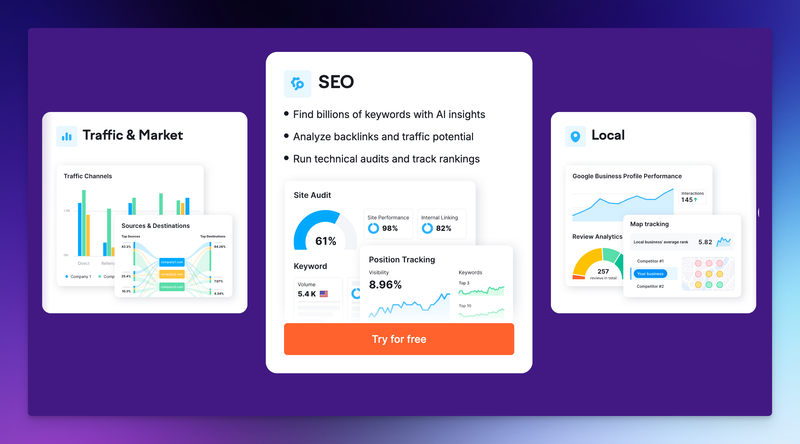
Semrush is one of the most comprehensive digital marketing software platforms available, covering SEO, paid search, content marketing, social media, and competitive research in a single interface.
It is the go-to for teams that need keyword data, site audits, backlink analysis, and content gap insights without cobbling together five separate subscriptions.
Best for: Content leads, SEO-focused marketers, and growth teams at companies actively investing in organic traffic and competitive positioning.
Key features:
- Keyword research and rank tracking across major search engines
- Site audit and technical SEO diagnostics
- Competitive analysis and traffic benchmarking
- Content marketing toolkit with topic research and SEO writing assistant
- Social media management and scheduling
Pricing: Plans start at around $199/month. Team plans are significantly higher. Annual billing reduces costs.
Honest Take:
Semrush is genuinely powerful, but it is also genuinely complex.
The data is excellent. The interface takes time to learn, and there is a real risk that smaller teams end up paying for capabilities they never use.
If SEO is a core channel for your business and someone on your team is dedicated to it, Semrush is worth the investment. If you are dipping in once a month, the cost is hard to justify.
HubSpot Marketing Hub
HubSpot sits at the intersection of CRM, email marketing, marketing automation, and analytics.
It is one of the top digital marketing platforms for teams that want a single source of truth for lead data and campaign performance.
The free tier is genuinely useful, and the platform scales well as teams grow.
Best for: B2B companies and service businesses that need to connect website behavior, email marketing, and sales activity in one place.
Key features:
- Email marketing with behavioral triggers and A/B testing
- Lead capture forms, pop-ups, and landing pages
- CRM integration with full contact activity history
- Campaign analytics tied to pipeline and revenue
- Marketing automation workflows
Pricing: Free tier available. Starter plans begin around $9/month. The professional tier jumps to approximately $800/month, at which point most meaningful automation features unlock.
Honest Take:
The free and Starter tiers are excellent for early-stage teams. The jump to Professional pricing is significant, and the platform can reward HubSpot-certified specialists rather than generalist marketers.
If your team is already using HubSpot CRM on the sales side, adding Marketing Hub is a natural extension.
Starting fresh with it at the Professional tier as a small team requires genuine commitment and onboarding time.
Canva
Canva has become a standard part of the online marketing tools list for a reason.
It removes the design bottleneck from content production.
Brand kits, shared templates, and a massive asset library enable anyone on a marketing team to produce on-brand visuals for ads, social posts, presentations, and reports without a designer in the loop every time.
Best for: Content teams, brand managers, and any marketer who regularly needs visual assets and cannot or does not want to wait on a designer.
Key features:
- Shared brand kit with logos, colors, and fonts locked in
- Thousands of templates for social, print, presentations, and video
- Real-time collaboration and commenting
- Simple video and animation editing
- Integration with social scheduling and publishing tools
Pricing: Canva starts around $10/mo per user with annual billing. The free tier is capable for individuals but lacks brand management features.
Honest Take:
Canva is one of the most adopted digital media tools in modern marketing teams for good reason.
It actually works, and the learning curve is almost nonexistent. The limitation is obvious: it is not a replacement for original design work, brand identity development, or complex visual production.
Google Analytics 4 (GA4)
GA4 is the current standard for web analytics and one of the essential marketing tools, because without measurement, every other tool on this list produces noise rather than signal.
GA4 tracks user behavior across websites and apps, models conversions, and integrates with Google Ads, Search Console, and most major marketing platforms.
Best for: Every marketing team that has a website and needs to understand what is actually driving traffic, engagement, and conversions.
Key features:
- Event-based tracking model for flexible conversion measurement
- Cross-device and cross-platform user journeys
- Audience building for remarketing in Google Ads
- Integration with Looker Studio for custom reporting
- Predictive metrics, including purchase probability and churn likelihood
Pricing: Free. The paid Google Analytics 360 tier is an enterprise product starting at a high cost, but for most teams in the 10 to 50 employee range, the free version covers everything needed.
Honest Take:
GA4 was a difficult transition from Universal Analytics, and many teams are still not using it effectively. The interface is less user-friendly than its predecessor, and the default reports are not always the most useful.
That said, it is free, deeply integrated into the Google ecosystem, and, once properly configured, provides more depth than anything in its price range.
Final Words
The goal of any marketing technology investment is the same: give your team the ability to move faster, work with better information, and produce results without burning out on operational complexity.
The best tools are the ones your team actually uses. That means choosing platforms that match your skill level, your workflow, and your actual problems, not the tools with the longest feature pages or the largest market share.
Start with the constraint that costs you the most time right now. Fix that.
Test the tools on this list against your real workflow.
Most offer trials or free tiers. The gap between reading about a tool and watching it save you three hours on a Friday afternoon is the only thing worth closing.
Turn your CMS into a growth engine – not a blocker
If every new landing page depends on plugins, developers and workarounds, it’s time to rethink your setup. With JET-CMS, marketing teams launch campaigns, multilingual pages and updates in hours instead of days – without plugin chaos or tech stress.

FAQs
Most of the tools on this list were designed specifically for non-technical users. JET-CMS, Canva, and HubSpot's basic features require no coding knowledge.
Several software tools help businesses manage social media scheduling and analytics in one place. Platforms like Buffer, Hootsuite, and Sprout Social let you plan and schedule posts across multiple social networks, including Instagram, Facebook, LinkedIn, and X (Twitter).
Operational tools such as a CMS or design platform deliver immediate results. Your first campaign change or landing page publish is the proof. Analytics tools require a few weeks of data accumulation before patterns emerge. SEO tools like Semrush operate on longer timelines; organic search improvements typically take six months to reflect.